NIKKO QUIROGA日光
About Nikko Quiroga

About Nikko Quiroga

I was supposed to become a doctor. A swallow tattoo had other plans.

My way into tattooing did not begin as a career move. It began with a classmate, a traditional swallow tattoo, and the strange feeling that an image can pull you into another world.

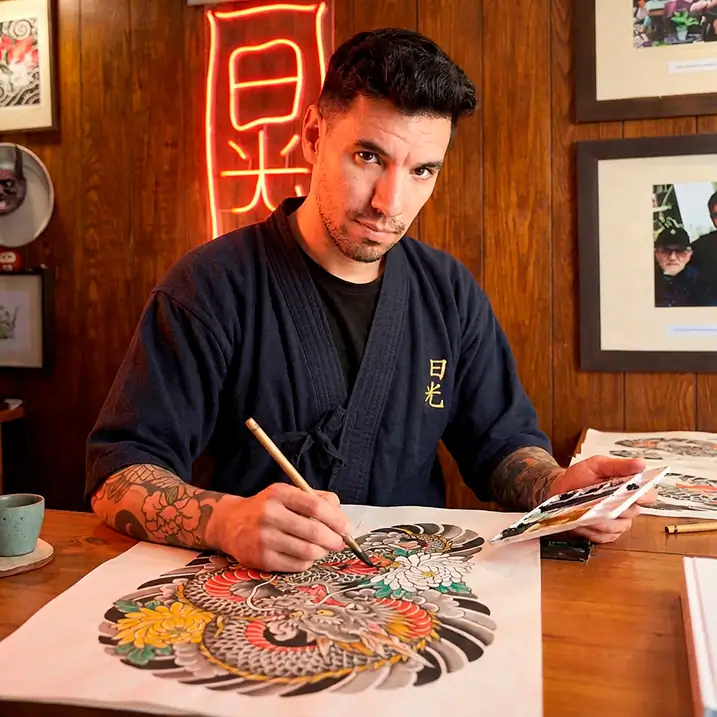
Portrait of Nikko Quiroga, Japanese tattoo artist in Buenos Aires

There was a plan. Luckily, it failed.

As a kid I assumed I would become a professional, maybe a doctor. That was the family plan, and for a while I tried to follow it. I went to medical school. It did not work. I went to psychology. That did.

But before all that, a tattoo had already opened something in me: a punk-rock classmate with a colorful American traditional swallow on his skin. I went home, connected to the internet through dial-up, and started searching for tattoos.

That search led me to full-body Japanese tattooing by Horiyoshi III, Yoshihito Nakano, the master from Yokohama. I did not know it yet, but horimono had already entered my life.

The studio, the buzz, the smell

At 19 I got my first tattoo: a swallow inspired by that first image. I still remember the studio in Martinez: neon signs, art on the walls, the buzz of the machines, the smell of antiseptic, and tattooers laughing.

In 2014, after a tattoo convention in Buenos Aires, I decided to begin. I bought my first machines, my first pigments, and started learning. My first tattoo took seven hours on a friend's arm. It was frustrating, real, and impossible to forget.

Japan, sake and a yakuza boy from Argentina

Japanese culture had been with me since childhood: martial arts, manga, cinema, calligraphy, myths and strange creatures. When I started tattooing, all of that found its direction: I would dedicate myself to Japanese tattooing.

In Japan I searched for books, images, stories and clues about horimono. It was not always easy. In Kyoto, after I took off my jacket while eating nigiri and drinking sake, an older man pointed at me and shouted: yakuza boy. We ended up talking and laughing.

That scene says a lot about the Japanese tension around tattooing: fascination, fear, myth and misunderstanding.

A private ryokan-like studio in Olivos

After my first trip to Japan I opened a private studio in Vicente Lopez. Later I bought my own place in Olivos and rebuilt it slowly by hand, inspired by Japanese ryokan.

I did not want a street shop. I wanted a quiet, private space where a person can slow down, drink tea, talk about the piece, and enter a different rhythm before the needle appears.

Psychology, philosophy and Japanese tattoos

I am also a psychologist, but I do not mix therapy with tattooing. In the studio, tattooing is tattooing. That background appears in the way I listen, frame the process, and read symbols.

In my podcast Tatuajes Japoneses I explore horimono, Japan and what I call Japanese cultures through psychology, philosophy, symbols and tradition. That study also supports my work as a tattooer: I do not understand Japanese tattooing as decoration, but as language.

Frequently asked questions

When did Nikko Quiroga start tattooing?

I started tattooing in 2014 and focused my path on traditional Japanese tattooing, irezumi and horimono.

Where is the studio?

I work by appointment in a private studio in Olivos, Vicente Lopez, Buenos Aires.

Does Nikko speak English?

Yes. International clients can contact me in English through WhatsApp or Instagram before visiting the studio.

If it is going to live on your body, it has to be thought through.

If you want a large Japanese piece that can age well, first we should talk about the story it needs to carry.

Talk about the project